What Autistic children learn from adult responses
We are all always learning. Every interaction, every experience, every mistake is a learning moment. It is wise of us as parents, as supporters and educators, to realize this and to question ourselves about what our children learn from our responses to them.
This graphic explores what an Autistic child learns from the responses of adults in their lives.
This graphic is published on hellomichelleswan.com with free access when attribution is given to its author. Copyright is held by Michelle Swan.
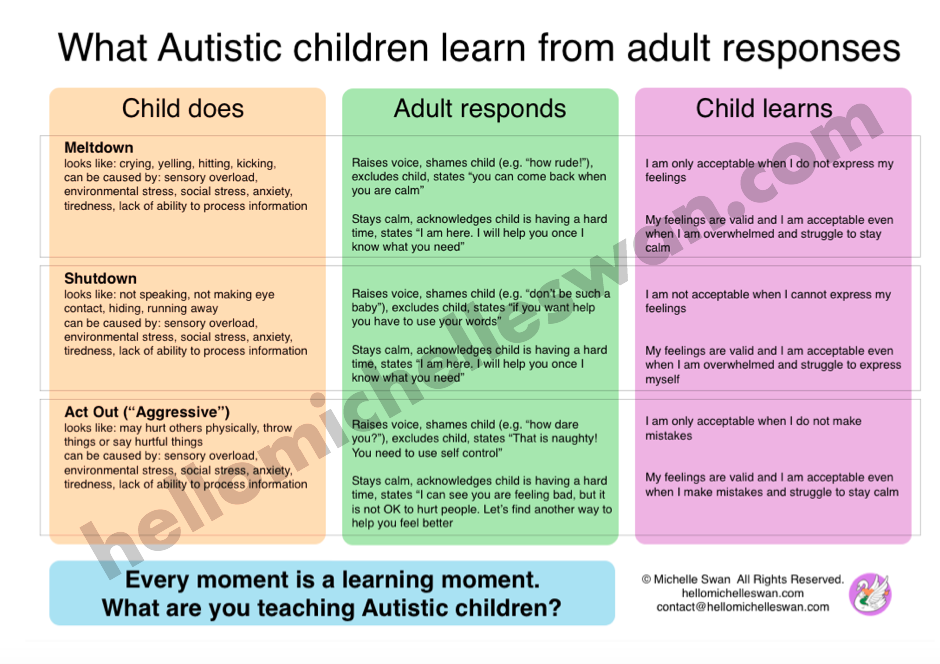
Image title: What Autistic children learn from adult responses
There are three coloured boxes on the page. From left to right blue with the heading “Child does”, light red with the heading “Adult responds”, then purple with the heading “Child learns”. In each square there are 3 sections going down the pageant each section spans the width of the page, so goes over each colour.
Information presented in each section reads as follows
Child does
Meltdown
looks like: crying, yelling, hitting, kicking,
can be caused by: sensory overload, environmental stress, social stress, anxiety, tiredness, lack of ability to process information
Adult responds
Raises voice, shames child (e.g. “how rude!”), excludes child, states “you can come back when you are calm”
Child learns
I am only acceptable when I do not express my feelings
Adult responds
Stays calm, acknowledges child is having a hard time, states “I am here. I will help you once I know what you need”
Child learns
My feelings are valid and I am acceptable even when I am overwhelmed and struggle to stay calm
Child does
Shutdown
looks like: not speaking, not making eye contact, hiding, running away
can be caused by: sensory overload, environmental stress, social stress, anxiety, tiredness, lack of ability to process information
Adult responds
Raises voice, shames child (e.g. “don’t be such a baby”), excludes child, states “if you want help you have to use your words”
Child learns
I am not acceptable when I cannot express my feelings
Adult responds
Stays calm, acknowledges child is having a hard time, states “I am here. I will help you once I know what you need”
Child learns
My feelings are valid and I am acceptable even when I am overwhelmed and struggle to express myself
Child does
Lash Out (“Aggressive”)
looks like: may hurt others physically, throw things or say hurtful things
can be caused by: sensory overload, environmental stress, social stress, anxiety, tiredness, lack of ability to process information
Adult responds
Raises voice, shames child (e.g. “how dare you?”), excludes child, states “That is naughty! You need to use self control”
Child learns
I am only acceptable when I do not make mistakes
Adult responds
Stays calm, acknowledges child is having a hard time, states “I can see you are feeling bad, but it is not OK to hurt people. Let’s find another way to help you feel better ”
Child learns
My feelings are valid and I am acceptable even when I make mistakes and struggle to stay calm
In an orange box across the bottom of the page are the words
Every moment is a learning moment.
What are you teaching Autistic children?
On the image(s) in this article the following copyright information is printed beside a logo that shows a purple circle behind a flying white swan that has a orange haired person wearing green clothes sitting on its back:
©Michelle Swan All Rights Reserved
hellomichelleswan.com contact@hellomichelleswan

Related Posts