

content note: discussion of the impact of reactive activism in the face of persistent threat…
ABC interview transcript April 2022
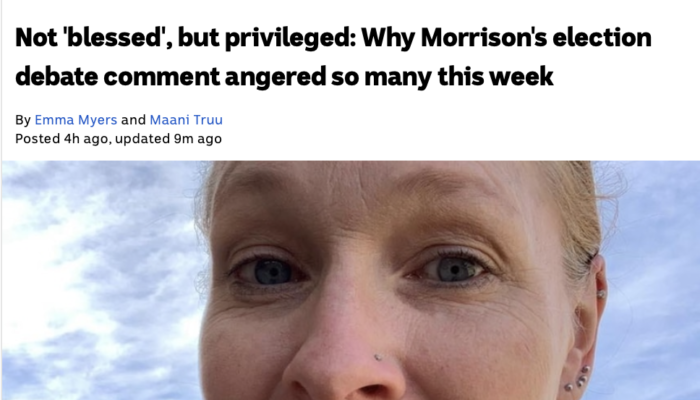
This past week Australia’s Prime Minister said something that has had disabled advocates speaking out.
I made a post on my Facebook page that received a lot of attention. click here to see the Facebook post
Then I was contacted by a journalist from the ABC who requested an interview so she could include my perspective in an article she was writing. click here to read the article
Obviously a journalist can’t include everything someone says in an interview!
I’d like to provide the full transcript of that interview here.
- What was your initial reaction to the Prime Minister’s comment re being blessed?
The answer to this is in my Facebook post :)
- What was your children’s reaction?
They were more angry than I was! They could see that by implication if he was blessed not to have children like them, then I must not be blessed to have had them. My younger children just said that he is rude and thoughtless. My oldest said that if Scott can see there is a situation that a minority group is in, and he concedes doesn’t want to be in that situation, and he has the power to change that, but instead disregards our needs, that is laziness and he shouldn’t be in office.
- How did the comments effect you as a mother?
Scott was asked a question about NDIS funding that he didn’t answer. Instead he made a half hearted attempt at appearing empathetic, said he was blessed to not have to go through that.
I know there has been debate about whether he meant blessed to not have to deal with the NDIS or blessed to not have disabled children. There is a pause in his speaking where he appears to consider on what he will say, and he chose his words in the moment. I think he could have meant either in a literal sense. But, in another way, I don’t think it matters. The only people who use NDIS are disabled people. So if he’s glad he doesn’t have to go through the NDIS or he’s specifically glad he doesn’t have disabled children, it’s the same thing!
I thought he was trying to appear to empathise with a parent, but what he did was essentially say I’m glad I’m not living your life. I felt that deeply. There’s nothing wrong with my life! I love my children. I like my children. (Those two things are different) They are amazing and a consistent source of joy and pride for me. They are the kind of people I wish the world had more of.
The challenges we face as a family are mostly due to having to navigate a world full of systems that weren’t designed with us in mind and don’t work for us. Scott didn’t continue on to say that he would do anything about that. He just said he was glad he didn’t have to deal with it!
- How does privilege come into what the PM said?
Firstly, he is not disabled and doesn’t have disabled children. He doesn’t understand our lives or our needs. He stated that he “can only try and understand your aspirations for those children”. He doesn’t have to tell the most vulnerable and intimate details of his life repeatedly to complete strangers and then rely on them to accurately convey their needs to another set of complete strangers, waiting months sometimes for an answer, in order to access the basic equipment and support he needs to be able to leave his home in the morning. That is privilege.
Secondly, Scott has financial resources that only a handful of people in the disabled community have access to. He cannot possibly understand the situations we find ourselves in trying to source the resources and equipment we need in order to live well. That is privilege.
Thirdly, Scott has a job that allows him to make and influence decisions about disabled peoples lives in a real and tangible way. Doing that while having limited understanding of what we need is not only privileged, it is dangerous.
Fourthly, Scott has access to resources, information, advisors, and communities that could help him to understand better and to do better. Yet he can choose to not use those resources, make decisions that are harmful, and still be supported and applauded by the majority of people. And when I speak out about this, as someone actually impacted by his choice to not understand, his supporters rally around to silence me. That is privilege.
- How did your religious upbringing effect your initial response to the comments?
It just meant that I understood, in a possibly more nuanced way than a lot of people, what he was saying with the words he chose to use. “Blessed” is used by a lot of people to mean lucky or fortunate. When a Christian person uses it, it is more than that. It means favoured by God. I found it disturbing that he, as a Christian, chose that word. I think it is inaccurate. He is privileged.
- What did you think of the PM’s apology?
I didn’t think it was an apology. It was a public relations statement. Saying you didn’t mean it that way but you’re sorry if people took it that way isn’t really an apology. A real apology would have acknowledged his privilege.
- How powerful do you think language is in relation to describing disability?
The exchange of language is what gives people the information they use to make decisions about how they will treat us.
There is a dominant narrative in our society around disability, in my case specifically autism, that speaks of us as though we are incompetent. Stereotypes contribute to this: Autistic people lack empathy, Autistic people have no theory of mind, Autistic people don’t understand social norms, Autistic people are in their own world, Autistic people are manipulative, Autistic people don’t want friends, Autistic people are violent, …. etc. I see parents of Autistic people using these exact phrases regularly when talking about their children. The result is that when people meet an Autistic adult they expect they can treat them as though they are dangerous, and have no interest in healthy human relationships.
I’ve been told that I should be quiet and not share my thoughts because I am Autistic and I don’t understand. I’ve been told my opinion is invalid because I and my children mustn’t actually be Autistic if I am happy with my life. This happens because people have been exposed to so much language that describes disability in negative ways that they cannot conceptualise anything else.
Scott Morrison is one of those people. He thinks disability is just bad and something to be avoided. He hasn’t heard disability spoken of positively, or he hasn’t listened. So he thought it was the right thing to do to show he thought he was in a preferable position to a mother of an Autistic child.
When disabled children grow up only hearing disability spoken of negatively the result is that they internalise that information and grow up believing themselves to be damaged, burdensome, and that something is inherently wrong with them. They struggle to self advocate for their needs because they think they are an inconvenience. They don’t develop a healthy sense of their own worth. It is a form of trauma that has long lasting consequences on their lives.
As a society, we don’t actually know the benefits of speaking positively about disability because we haven’t done it. In individual family units, and in some disabled communities we know the benefits. We see people arrive post diagnosis in a mess of pain and anxiety because they’ve been told something about themselves that they think they should be ashamed of. And we see them slowly heal and gain confidence and a sense of worth simply because we told them they are actually part of what is normal and valuable in this world.

Related Posts


