

content note: discussion of the impact of reactive activism in the face of persistent threat…
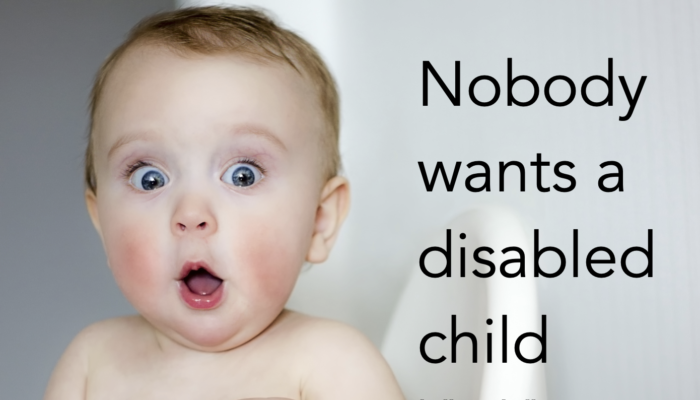
“Nobody wants a disabled child”
10 years ago, before I knew I was autistic, but after two of my children had been diagnosed as autistic, I was pregnant. And someone asked me if I was worried my baby would be born autistic.
For context, at that stage I did not have an “easy” life. I was already raising 5 children, all neurodivergent. My children have a collection of diagnoses and challenges that stun most people I tell about them. I’m not sharing that information with you here. It’s not something you list for the whole internet to read. We were in the middle of a long period where our challenges seemed bigger than our strengths, let’s say that.
So, was I worried my baby would be autistic? Absolutely not. In fact, I hoped they would be.
You see, I know autism. I’m comfortable with autistic children. I understand them. More than that, I like them. I appreciate their sensitivity, their style of humour, their unique approaches to problem solving, their honesty, their authenticity. I love how autistic children feel their way into spaces. I love how they look at the world and appreciate the little details many don’t notice. I love how earnest they tend to be and how completely they pursue their interests and passions.
Give me an autistic child any day!!
Most people would agree that to be autistic in this world is to be disabled.
So, if you thought you didn’t know anybody who wanted a disabled child, you were wrong.
I did.
I wanted an autistic child.
If I were pregnant again now, I would want an autistic child again. Unashamedly.
I want you to pay close attention to the words I am using.
I am saying “disabled child”, not “child with a disability”.
It’s a really important distinction.
If you aren’t familiar with the social model of disability, can I ask you to pause your reading and go and watch this video? It will open in a new tab, so you can come back here easily when you are finished. Click here to watch.
A lot of people think that disability is something wrong with the person. I accept diversity as a normal part of the human experience. This diversity includes brain differences, sensory system differences, body differences, limb differences, facial differences, … all of it!
Being autistic is a natural difference and a normal part of the human experience. Autistic people don’t have something wrong with us. We just need specific things in our lives to help us live well.
***
I don’t “have a disability”. I am disabled.
I am disabled by unwelcoming sensory environments.
I am disabled by unachievable social expectations.
I am disabled by ambiguous communication.
I am disabled by systems that assume executive function proficiency that is difficult for us to achieve.
I am disabled by societal insistence on particular communication style, adherence to routines and compliance with systems not designed for us.
Autism does not disable me. For my family, in our home, where we have control over environment and expectations, where we decide how our needs are met, we aren’t particularly disabled. It’s when we go out that we struggle! External expectations, pressures and assumptions disable us. I acknowledge that not all autistic people, not all disabled people, feel this way. For my family it is true. I know other families for whom it is true. This is our experience.
***
And so, even though I previously disagreed with the statement that nobody wants a disabled child, I am now going to agree. I don’t want my child to be disabled.
I want my child to be accepted and valued just as they are, and for people to recognise their worth and be willing to support my child to live well in this world.
I don’t wan’t my child to be disabled.
I do want my child to be autistic.
See how it’s actually not so simple?
But, if I am going to use language accurately, right now, while the world still disables autistic people…. Then technically I do want a disabled child.
*** The text between the *** markers in this article has been edited since I first published it.
When I wrote this article I did something I don’t usually do.
I wrote “we” in a few sentences.
Usually I would write “I”.
I have adjusted the article to be consistent.
The consistency is important to me because when I write I am sharing my experience, and I know that it is not the same as all autistic experiences. I never intend to try to represent all autistic people. It is impossible, and it would be inappropriate!
In this instance my first publishing of this piece communicated something I did not intend, and so I have changed it now to better reflect my values.

Related Posts


