You don’t seem Autistic
Content note: This article contains my thoughts on being told I don’t seem autistic.
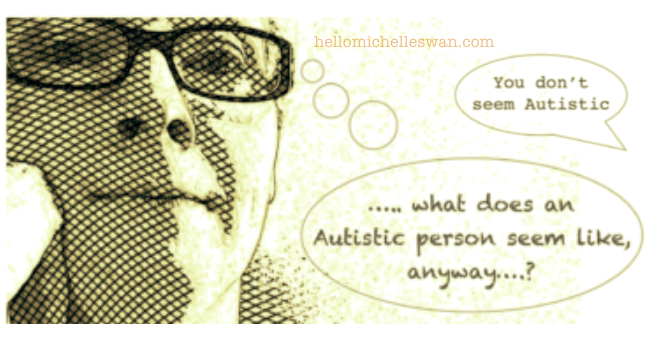
“I hope I don’t make you uncomfortable by saying this. But- you don’t seem Autistic.”
I immediately wondered what I would have to look like for this person to take me at my word. Did I not look Autistic because I was speaking confidently about a topic I know a fair bit about in front of a group of people? Maybe because they hadn’t expected the person facilitating a workshop about supporting a disabled person to be Autistic?
And really, how does an Autistic person “seem”?
Shortly after this comment was directed at me I saw a great tweet by Gregg Beratan:

image: screen shot of Greggs tweet, which reads “Am I the only one who dislikes the word able-bodied? Just think it lets credibility to the lie that Disability & Ability are a binary.”
I agree with Gregg. I am both disabled and able bodied. The two aren’t mutually exclusive. My understanding of what people mean when they say able bodied is someone who is not physically disabled. I am able bodied.
Being disabled does not only happen when someone is physically disabled. We can be disabled by environment, expectations, overwhelm, overstimulated sensory systems, challenges with executive function, inability to communicate the way most people do, and many other things.
We don’t have to “seem” or “look” or “appear” disabled to be disabled. We can also be disabled in some situations on some days, and not so disabled on other days. We can even be more, or less, disabled by the same things on different days or with different supports or lack of them.
We really need to get active about challenging the assumptions made about disability in our society. We need to find ways to change the conversation. It is important to let people know that disability is common, and not always visible in the ways they expect.
I honestly don’t mind answering questions about my experience. I actually enjoy talking with people who have a genuine desire to hear a different perspective and understand where I am coming from. I don’t like it when people start a conversation to correct me, as this person wanted to. It didn’t matter what I said to them, they persisted with telling me labels were restrictive and bad and wouldn’t let me speak to the fact that I found the self understanding gained with realising I am Autistic truly liberating- they kept interrupting. In the end I just jotted down a couple of websites they could look at if they wanted to understand neurodiversity and the social model of disability better.
In this instance I found it very difficult to discuss because I wasn’t prepared. I need to think about things and write them down to clarify my thoughts and develop scripts before I confidently respond in person to this sort of comment. I’ll be better prepared next time.
Next time I will say, “Disability doesn’t always look how you expect it to. Not all disabilities are physical or observable just by looking. Sometimes you won’t be able to see it at all, unless the person feels safe enough to disclose it to you either in words or behaviour. You definitely won’t see what the person does in private to ensure their needs are met, and you likely won’t notice many of the things they do to cope when they are in public. There is an issue of safety in disclosing disability in our society. Many of us hide our disability. When we disclose we are often not believed, or then presumed to be less competent than others. Many disabled people don’t disclose because they understand society expects us to just get on with life without inconveniencing the non-disabled with requests for equality or having our support needs met. So, while I can understand your confusion over my disclosing my disability, it is based on misunderstandings arising from a society that routinely discriminates and makes it unsafe to disclose. But we are here, often getting our support quietly from each other in private communities we can only access after we receive the gift of a label that helps us understand ourselves.”
Or something like that.

This article is featured exclusively at hellomichelleswan.com.
The content of this article is the intellectual property of Michelle Swan, and is copyright.
Permission to reproduce this article, in part or in whole, can be sought by emailing contact@hellomichelleswan.com
click here to read full disclaimer, attributions and acknowledgements page (opens in a new tab)

Related Posts