

content note: discussion of the impact of reactive activism in the face of persistent threat…
I want to be wrong about Julia
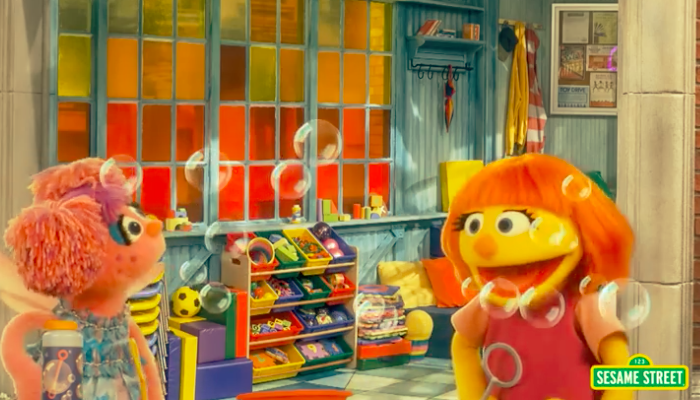
Content note: this article discusses, from the perspective of an autistic person, some problems with the new Julia character on Sesame St. TV
I first posted the following thoughts to my facebook page, but post them here now as well.
1. The fact Julia “has autism” tells us that the autistic community was not closely consulted when developing this character. If they had been, Sesame St would say Julia is autistic, as that is the identifying language preferred by most of the autistic community. It is a deliberate choice to use identity first language instead of the popular with parents and professionals use of language that “puts the person first” so folks don’t forget that autistic people are in fact people.
2. In introducing Julia the media is reporting a lot of stereotype and stigma based rhetoric, which they are getting from interviews with Sesame St employees. This is because the employees involved in the development of this character are not autistic. Some are parents of autistic children who are being presented as experts in autism.
Please remember: the only true experts on autism are autistic people themselves.
3. Julia is not a new character. She was first introduced in 2015 as part of an awareness raising campaign (more about “awareness” another time, but those of you who’ve known me a while will probably know what I think of that already). Autistic people spoke out then about the problematic nature of the character and the way she is portrayed.
My favourite article about this was written by Erin Human. You can read it here: https://erinhuman.com/2015/10/23/not-in-love-with-julia/
My favourite quote from the article is “This digital storybook is the only place where Julia the autistic muppet appears, as a cartoon drawing. And yet, the book is told entirely from Elmo’s point of view, as he explains the things that Julia does and feels. Given the creative freedom of a fictional cartoon storybook, how is it that even in this format the autistic person can not be the narrator of their own story? Sure, most children are not autistic, but is that a good reason to sideline autistic children into always being the object of the story and never the subject? Sesame Street could, and really really should, do better than that.”
4. I really, really want to like Julia and the way she is presented by Sesame St. It is important to have representation of all kinds of diversity in media. Autistic kids sure could use a positive portrayal of themselves in mainstream tv, a role model who will help them learn about pride in yourself, the value of diversity, skills needed for self care and advocacy, the basics of upholding human rights, …. but I fear this won’t be it.
I’m totally willing to be proven wrong here, in fact I hope I am. But for now, I remain skeptical, and to be honest I’m wary of all the parents who are enthusiastically declaring their child will benefit from seeing Julia on tv.
Please approach this with caution and listen to the feedback that autistic people give it.
A couple of days after posting the above thoughts to my Facebook page, and having watched the introductory Julia videos, I find myself just as conflicted. The videos actually weren’t as bad as I expected, and there were some good things about the way Julia was portrayed. It is obvious that the creators have made an effort to present Julia using an atypical style of verbal communication, and that they have intentionally portrayed that as acceptable and valid. They have done the same with her atypical style of play.
But I am un-nerved in a different way. As I watched Elmo and Abby interact with her, I was left with a feeling that there was a power imbalance there. This was not a true peer friendship, but a dynamic where Elmo and Abby were considered to be the helpers of Julia- there to interpret and to fill the gaps she was not competent to fill herself.
In one video Julia and Abby are blowing bubbles together and popping them. The bubbles float out of Julia’s reach and so Abby, without asking what Julia wants to do about it, announces that she will pop them for Julia.
I know, I’m looking at tiny details in a kids show and I’m picking it apart. I know I’m going to be criticised for it.
But the thing is, in our society disabled people experience a constant stream of micro-aggressions that occur because we are seen as less able. People want to help, and they will help- whether the person they are helping likes it or not.
And in our school system it is all too common to see programs set up to help the disabled kids- buddy systems where the non-disabled are encouraged to, and rewarded for, being “friends” with disabled kids.
This so called altruistic behaviour is not actually helpful though. It sets up a relationship based on imbalanced roles, where one person helps another who needs to be helped and is rewarded for their efforts. I’ve seen promotional videos that say they are an example of inclusion, in which the non disabled kids feedback that they like having the disabled kid around because they “teach me to be a better person”, or they “have a lot to offer”, and other platitudes. But disabled people aren’t here to be a learning moment, and they don’t need to have stuff to offer to be valuable as a person.
The whole “I’m going to help you” and “I’m going to interpret for you” and “I’m going to look after you” aspect of the Julia videos I watched leaves me thinking the purpose of Julia has nothing to do with supporting Autistic people, and everything to do with teaching non autistic people how to tolerate us and to decipher the code to having us share space with them without disrupting it too much. I hope I’m wrong.
I wish it was about rights and advocacy and empowerment for autistic people. But I don’t think it will be. It’s an opportunity to show autism in media in a way that autistic people can relate to and be proud of, but I that opportunity may have been missed. And instead, to me it looks like it’s just going to be another neurotypical interpretation of how other people can help us and make our tragic lives better. Please let me be wrong.
You can watch the videos of Julia here: http://autism.sesamestreet.org/videos/kids/
Let me know what you think. (Comments on this blog are moderated, so they wont appear immediately. This is so I can read and think about them before they are published and then publish when I have time to respond, as well as giving me an opportunity to choose if I will publish at all in the case of comments that are aggressive, abusive, disrespectful of autistic people, or likely to be triggering for autistic readers of this blog.)

This article is featured exclusively at hellomichelleswan.com.
The content of this article is the intellectual property of Michelle Swan, and is copyright.
Permission to reproduce this article, in part or in whole, can be sought by emailing contact@hellomichelleswan.com
click here to read full disclaimer, attributions and acknowledgements page (opens in a new tab)

Related Posts


