

content note: discussion of the impact of reactive activism in the face of persistent threat…
TeachMeet Human Rights
4.
TeachMeet Human Rights
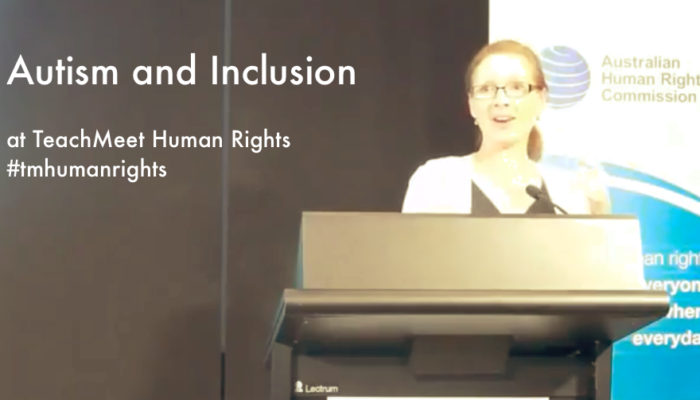
On Tuesday 14 March 2017, I attended TeachMeet Human Rights in Sydney. It was a wonderful event, with many excellent presentations. I was honoured to be invited to present a 7 minute talk on Autism and Inclusion. This post contains the transcript of my presentation.
Inclusion in education is a human right, yet there is much about our education system that makes it inaccessible to autistic students. I spoke about the experience of autistic students and how to make schools and classrooms more welcoming and accessible, using strategies to avoid the practice of seclusion and restraint that we have seen occurring recently.
In this post I am including a link to where you can watch the whole event, a copy of the presentation slides I used, and the transcript of my talk.
To watch the presentation click here to visit the Australian Human Rights Commission Youtube channel (my presentation starts at 37:00). Clicking the link will open a new window, so you can watch and then come back here easily.
Here is the PDF version of my presentation slides: Autism and Inclusion {Michelle Sutton for TeachMeet Human Rights}
(Please note sincethis presentation my name and contact details have changed. The details in this presentation are no longer correct. My current email address is contact@hellomichelleswan)
And below is the content of my talk:
Hello, I’m Michelle. I’m an autistic woman, raising autistic children, and working as a neurodiversity rights advocate and peer support mentor. Thank you for the opportunity to talk to you about Autism and Inclusion in classrooms- how to do it well, and model upholding rights to students. 7 minutes isn’t long to cover this topic, so I’m going to use some slides to give you extra information. Feel free to photograph the slides. There are also print outs of the slides you can take.
So, what is inclusion?
Inclusion is a human right
In August 2016 the United Nations Committee on the Rights of Persons with Disabilities adopted General Comment No. 4 to Article 24 – The Right to Inclusive Education, to clarify what inclusive education is and what State Parties responsibilities are in relation to it.
Inclusion advocate Catia Malaquias wrote this paraphrased version:
“Inclusive education means, the delivery of education services to all students grouped with age peers in general mainstream education classrooms in a way that addresses and responds to their diverse characteristics as learners, provides reasonable necessary supports and respects their fundamental human rights. For the avoidance of doubt, inclusive education does not include the delivery of education services in environments that segregate or congregate learners with disability, whether in separate educational institutions, separate classrooms or subsections of classrooms.”
What is happening in Australian education settings now?
Well, some autistic students are still segregated, and some are “mainstreamed”. From my work with Autistic Families International I know that primary and high school aged autistic students in Australian schools experience bullying, seclusion and restraint- both n mainstream and segregated settings.
In 2016 we presented a submission to the UN on behalf of 56 students who had been mistreated at school. In every case we presented, the autistic children were mistreated in ways that would have seen staff reprimanded if they had done the same things to a non-disabled student.
Staff used martial arts techniques on autistic students, put them in head locks, dragged them down hallways, locked them in cupboards and cages, and tied them to chairs. These violations were justified because the student was autistic. Actions were excused by saying they were part of a behaviour management plan, or done for the safety of the student, their classmates or the teacher.
Of course it is absolutely necessary to keep everyone safe at school. So, there is a need to understand autistic students experience of school and develop strategies that will ensure everyone is safe and feels safe.
The experience of Autistic students
Schools and classrooms are not environments that are set up to support autistic peoples needs. Autistic people experience sensory challenges- and as part of that language processing difficulties, as well as social confusion, and executive function challenges, all as a result of the environment and expectations put on them.
The following graphic explains some of the sensory challenges faced by autistic students in classrooms. It covers challenges to the sense of hearing, touch, sight, and smell. Autistic people also experience challenges to their vestibular and proprioceptive sensory systems.
It doesn’t matter if the autistic person is noticeably disabled or not, their experience of a typical classroom is going to result in overwhelm. It is common to hear people refer to high functioning autism, or mild autism, or level one autism, but those functioning labels are telling you about the non-autistic persons experience of the autistic persons autism. There is nothing mild about an autistic persons experience of the feeling of a shut down or meltdown due to sensory overload. The fact they can hold it together at school until they can get home to a safe space and fall apart in private does not mean they don’t need support while at school.
Having your experiences and needs unacknowledged will result in feeling the need to either “act out” in order to be heard, or retreat and hide to cope. This is because the overwhelm autistic people experience triggers their fight or flight response. This can happen multiple times in a day, and as you can imagine, it is exhausting.
Strategies to support Autistic students
As well as addressing sensory needs, there are things we can do in the way we structure classroom activities that will make learning easier.
Minimise large group instruction time, with enough teachers and resources to provide small group and individual assistance for all learning experiences.
Minimise bookwork and be aware of the difficulty many students have with text heavy learning.
Facilitate hands on and interactive learning experiences as a supplement or alternative to text based learning as appropriate to meet individual needs.
Allow for the use of assistive technology as both a learning tool and a coping strategy for anxious and overwhelmed students.
Include students as planners and decision makers, with teachers as facilitators and collaborators whose goal is to assist rather than enforce compliance.
The next graphic addresses practical ways to support some sensory needs. There are tips for providing support for students who are sound, touch, sight and smell sensitive.
And lastly, I’d like to talk about the need to change the way we approach behaviour management. There are so many therapy options that require the autistic person to make internal changes to suit the desires of the authority figures around them. Most of these are harmful to autistic people. It is vital that we avoid the temptation to manage behaviours, and replace it with the goal of meeting needs.
This shift in approach requires a shift in thinking. We must view each student as a person who has needs, and has the right to have those needs met, even if they are different than other student’s needs, different than expected, or even if they are in fact difficult to meet.
We must accept that it is a normal human behavioural response to having our needs unacknowledged and unmet to lash out aggressively, to engage in attention seeking, and to do things others find annoying. Any of us would do that (and we do) if put under enough pressure and if we feel unvalued and unheard. In the case of children, we must admit that as adults we expect children not to do things that are typical human behaviour, and that is not fair.
Behaviour is communication.
As adults, and people in positions of power, we must accept the responsibility of altering things about the environment we can control in order to meet the distressed child’s needs. We must acknowledge that sometimes we need to change things about ourselves and our behaviour in order to better support the student.
We must allow the student autonomy and respect their communication, even though it may not be a communication style that we think is ideal. We cannot ignore the message because the style of communication makes us uncomfortable.
We must listen and ensure their needs are met. These strategies will reduce the frequency of challenging or confronting behaviours, and model upholding human rights to all students.

This article is featured exclusively at hellomichelleswan.com.
The content of this article is the intellectual property of Michelle Swan, and is copyright.
Permission to reproduce this article, in part or in whole, can be sought by emailing contact@hellomichelleswan.com
click here to read full disclaimer, attributions and acknowledgements page (opens in a new tab)

Related Posts


